Sour Cherry Review & Final Thoughts
“Ghosts always exist in the present. They’re like scars that way. In the past, they’re wounds. In the future, who knows? (212)
I’m in disbelief at how quickly time has gone by that my initial post about reading Sour Cherry was three weeks ago! It did not take me that long to read the book, in fact it took me less than two days because I was quickly and absolutely absorbed in it. I became a ghost haunting the narrator, waiting for the ending to come. And now that it’s over my life feels somehow different. The gap in posts has more to do with not feeling able to sort through all my thoughts about the book and even a little avoidance because I want to do the subject matter justice. But no matter, at long last, my final thoughts on Sour Cherry by Natalia Theodoridou.
I believe the Brothers Grimm would find this retelling worthy of praise. Powerful in its subtlety, Sour Cherry offers a new lens on domestic violence. Not only the monsters who perpetrate it but also those that are complicit and contribute to the silence of its victims. It contains traditional gothic elements and contemporary horror elements but veers away from ever getting too close-up and personal with anything graphic or terrifying. The genius of the book is that the ghosts and plagues that follow the characters everywhere are so pervasive it becomes its own repetitive cycle that the characters dismiss.
Time
The book bounces back and forth between narration of a fairy tale story and the narrator’s ambiguous present time. The ‘present’ is marked by a black border until the end when the stories merge, and all of the pages are in standard formatting. No one is anchored to any sort of reality, instead time feels almost non-existent yet ongoing into forever.
Reading an interview in Electric Literature, the author says this about time:
NT: “Cherry Girl at some point says that, with stories of abuse, “the people are us, the time is always.” The flattening of time in this way enables us to speak to the commonalities in stories of abuse without erasing the singularity of each one. Isn’t this what allows us to see ourselves in stories in general?”
There are numerous characters who all play a role, but recurring often are the Cherry Girl/unnamed narrator, the unnamed man who is a child at a the start of the story, Agnes (who may or may not transition to a person known only as Cook), the first wife Eunice, and the man and Eunice’s son Tristan. There are a few other minor characters who make appearances at various points. Then, of course, there are the ghosts of all the wives, who we meet throughout and show up in both the fairytale and in the narrator’s present.
Names
A major element of the story is a loss of names and identities, the characters in the book are often just victims including the perpetrator of the violence, the man himself. Not all wives are even given a chapter in the fairytale, let alone a paragraph, or even a moment. Some are lost to time. The women became ghosts long before their deaths.
Whose story is it really? Where do they blend and merge and become inseparable from one another? From the same interview, the author had this to say about the “flatness” of characters in fairytales:
NT: “Fairy Tale Is Form, Form Is Fairy Tale” argued that the “flatness” of characters in fairytales “functions beautifully; it allows depth of response in the reader.” I think the absence of names functions in a similar way. So I think the loss of identity is not specific to feminine characters. In fact, the Bluebeard man doesn’t have one either. In letting go of proper names and retaining only their functions, the people in this story do two things: one, they expose the utilitarian way in which Bluebeard relates to them. And two, they relate in a less context-bound way. This is precisely what the fairytale style of naming (a King, a Hunter, a Woodcutter) does, and it is part of what makes fairytales resonant in a wider variety of contexts. This story could be anywhere, any time.”
General Trigger Warnings
There is a grotesque nature to the book - imagery used to show the inherent violence of the main character's monstrous nature.
There is a lot of death, honestly. There is unfortunately no shying away from it in a piece of fiction like this. People die, animals die, nature dies. But unlike most books that use the deaths for shock value or general gore, these deaths are the cause of the main character's rage and pain. That doesn’t make them any easier to read, but the author handles them with some nuance.
Ultimately it is a book about domestic violence. Take care of yourself as you read this book.
Final Thoughts
I struggle with the idea that there is no place for a story like this in literary/contemporary fiction. Or even within mythology. Instead terrible things must always be lumped with horror. At the bookshop I work at I asked to remove it from horror and instead place it on our shelves that we designate as “Stories that Resist Classification”. A perfect place for stories like these, that mainstream publishing have to find a home for and often lean on common tropes to categorize, but in reality don’t fit into a neat and tidy box.
I believe this is a good start in the genre for anyone looking for a beautifully-written and engrossing contemporary fairytale.
Final Scaredy Cat Rating - One Ghost 👻 (Barely Scared) but very haunted by the subject matter and depth of this novel.
I highly recommend reading the book. If you plan to, stop here because you won’t want to spoil the ending. If you are ok with spoilers, continue reading for the rest of my thoughts.
Bonus Thoughts (Spoilers!)
I’ve decided to talk about my bonus thoughts based on the passages I ended up saving and the parts that I can’t stop thinking about. Apologies for any rambling, I wanted to make these observations thoughtful without sounding like a high school English paper.
—
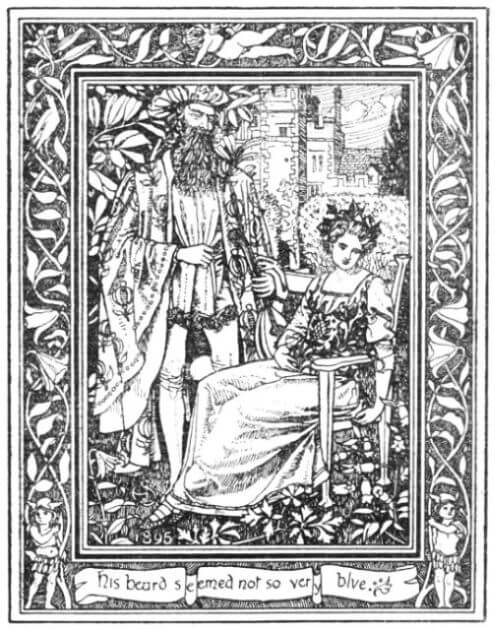
“She [Agnes] had always known not to be curious. Her mother had told her a story, once, about a lord and his strange beard, and about his many wives, each succumbing to her curiosity, peeking where she shouldn’t and so meeting her end” (25).
I loved this nod to the original story. A story within a story. This isn’t the only time it is referenced either - Eunice (the first wife) also mentions the fairytale of Bluebeard. It speaks to the idea of women’s curiosity that I discussed in my initial post before reading the book.
"The trivialization of women’s curiosity so that it seems like nothing more than irksome snooping denies women’s insight, hunches, and intuitions. It denies all her senses” (Estés 51).
Of all the characters, it is Agnes who most denies her senses. She is complicit in the man’s behavior and cycles of violence. Only asking him to apologize after he’s hurt someone, but not holding him accountable to his actions.
—
“There were hidden rooms in both of them that the other would never see” (68), along with,
“Her [Eunice’s] husband used to say every person was a house, and that there were hidden rooms in both of them as in everyone. For a time, he had been right…Not anymore. He had raided those rooms. Ransacked them. Her house was empty. Not even Eunice lived there” (120).
I appreciated these two quotes even more once I reached this quote:
“What was in the husband’s secret room when the first wife discovered it?” (124)
Is it the mere fact that she discovered he had a secret or hidden room that made him so angry he felt he needed to do harm. Was it the mere fact that she was simply curious that was her downfall, as Agnes pointed out, or was it the fact that she had a sense at all. It was easiest for him when his wives were ghosts, when they didn’t prod or cause trouble because he then didn’t have to feel angry at them and thus cause the plagues and deaths. They are simply utilitarian to the man until they are no longer useful or cause too much trouble. This is often a phrase victims will say when trying to blame themselves, “if only I had done what he said” or “it’s because I did [blank] or didn’t do [blank]”. But the truth about power and control, which is the base of domestic violence, is that it doesn’t matter what the victim does or doesn’t do, the perpetrator of harm will always blame them for their own internal issues, anger, and ultimate destruction. The perpetrator never takes any blame, which we see over and over again throughout the novel.
The man collects women like trinkets in his curio cabinet, wishing them to be fragile so he can care for them, but ultimately silent and only good for viewing. There is lots of imagery around silence and silencing. Animals and people fall silent when the man and his wife move into town, the ghosts are silent, and there was this great passage (I unfortunately didn’t highlight it and can’t find it now) but after someone has passed, I believe the son Tristan, Eunice finds only handfuls of leaves filling his mouth.
—
“I still don’t know why you’re here, I tell the ghosts…So that not one of us ever thinks she’s alone” (230).
I loved this quote the most. There is nothing more important than a supportive community for someone who has been a victim of domestic violence. Whether that is community based health services, mental health support, child support, advocates, justice, etc. The most power a perpetrator can possess is when they have made the victim feel like they are completely alone and isolated, which is a tactic of perpetrators. And this is shown in the novel, moving to a new town constantly, leaving everyone and everything behind. The wives are always alone in the home, because even when the villagers are initially friendly, they always become wary. That is the goal of the perpetrator, complete isolation and reliance on them solely. Even when Agnes/Cook is around in the novel they are both a victim and complicit to the victimization of the wife.
So, what happens next, how does the story end? I appreciated that there wasn’t a happy ending, because often in real life there is no happy ending. The book shows reality, a cycle of violence that continues unchecked. On top of that, it's the subtlety of the violence. Not loud and all consuming, quiet, tender even. Reality is obstructed by kindness and misunderstanding and apologies. And that violence doesn’t just impact one person, but the entire community. The children, the elderly, the animals, and nature. As the reader is exposed to it, the more numb we become to it. Those that try to fight it are always hurt. The sacrifice of the last wife is impactful. If she stays, no one else gets hurt.
I could go on an entire rant about the wife who was a baroness - the only woman with wealth and connections in the story so she gets away. She becomes ill and her father comes and takes her away. She had the means and the privilege to escape, unlike the other wives.
I won't give away the real spoiler, the ending, because it's too impactful to spoil and out of the context of the book doesn't hit the same. I will definitely read this book again to appreciate the full scope.