Scary Read #1: Sour Cherry Pre-Read Impressions
“There is a hank of beard which is kept at the convent of the white nuns in the far mountains. How it came to the convent no one knows. Some say it was the nuns who buried what was left of his body, for no one else would touch it. Why the nuns would keep such a relic is unknown, but it is true. My friend’s friend has seen it with her own eyes. She says the beard is blue, indigo-colored to be exact. It is as blue as the dark ice in the lake, as blue as the shadow of a hole at night. This beard was once worn by one who they say was a failed magician, a giant man with an eye for women, a man known by the name of Bluebeard” (39).
And so begins the tale of Bluebeard as told by Clarissa Pinkola Estés, Ph.D., from her book Women Who Run With the Wolves (1992) which is where I first read the fairytale. Her telling of it seems to match that of the original French folktale, first published by Charles Perrault in 1697. In which, Bluebeard, a wealthy but terrifying man with a blue beard, lures women to marry him through lavish and cheerful means. Once settled into his home, he leaves on a trip, entrusting the castle to his new wife. She is free to explore every room and he even provides her his key ring, including one small key that fits one particular door. She is prohibited from entering that room. Of course, as fairytales often go, after unlocking every other door in the castle, she is curious as to the last key and is able to find the door. So it is revealed that within the room are the dead bodies of his former wives. She slams the door but finds that the small key is weeping blood, and no amount of scrubbing, scouring, or washing will clean it. She hides it in her wardrobe and upon his arrival home, tries to claim she lost it. The key, though, has created a pool of blood in her wardrobe and in his anger he moves to kill her. She is saved through her wit and the help of her visiting brothers, who slay Bluebeard.
While it may seem like an obvious lesson that one shouldn’t be curious and instead be obedient to rules set, that would be a cursory and simple (not to mention problematic) understanding of the tale. Instead, consider the idea that our protagonist was able to uncover a truth despite ignoring her initial intuition. She is initially wary of Bluebeard, but is won over and dazzled by his wealth and charm, abandoning those initial fears. It is luckily through her curiosity that she regains that insight enough to question why there would be any locked or off-limits rooms in her new home. As Dr. Estés writes, “the acquiescence to marrying the monster…” is because, women in particular, “are taught not to see, and instead to ‘make pretty’ all manner of grotesqueries whether they are lovely or not” (48). Even the mother colludes on this decision to have her daughter marry Bluebeard.
“The trivialization of women’s curiosity so that it seems like nothing more than irksome snooping denies women’s insight, hunches, and intuitions. It denies all her senses” (Estés 51).
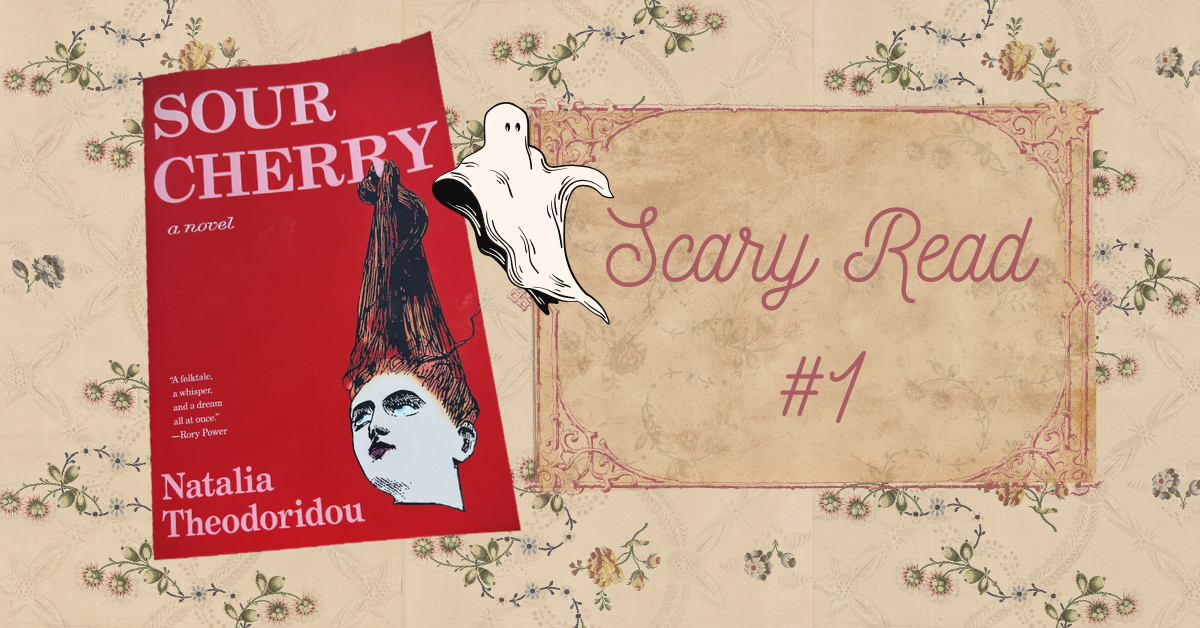
Having fallen victim to abandoning my own intuition and the dazzling wiles of others in the past, I have always felt drawn to this fairytale. So it was to my surprise and delight that I was unpacking new releases at the bookshop and pulled out Sour Cherry by Natalia Theodoridou (2025). Occasionally you should judge a book by its cover if it is so intriguing that you have to read the book description, which is what happened in this case. I was excited to see that it was a retelling of Bluebeard. I was further sold when one of the reviews name-dropped Carmen Maria Machado as a comparative author (In the Dreamhouse – a must-read).
To avoid spoilers I’ve only read the description and reviews provided by the publisher, Tin House. Per the publisher:
“A stunning reimagining of Bluebeard—one of the most mythologized serial killers—twisted into a modern tale of toxic masculinity, a feminist sermon, and a folktale for the twenty-first century.”
“Sour Cherry confronts age-old systems of gender and power, long-held excuses made for bad men, and the complicated reasons we stay captive to the monsters we love.”
I love the idea of modernizing the tale of Bluebeard for current audiences. Afterall, the initial folktale is from at least the 17th century (if not earlier), which speaks to its ability to hold up but also begs for reimagining as the world has certainly changed drastically since then.
While I’m at an advantage reading the book because I know the fairytale, I’m still terrified by what possible grotesque and horrible things will happen. Dead bodies in a room are still dead bodies no matter how eloquently or interestingly you write them.
My prediction for how terrified I will be after this is One Ghost 👻 (Barely Scared). I’m really hoping my prior knowledge really pulls through. Wish me luck!